



Senior marketing leaders make judgment calls constantly. That's the job. But decisions that affect budget, creative direction, or market positioning need more than confidence behind them. They need to survive organizational scrutiny and earn support across the business, like:
- Buy-in from leadership (who are accountable for business outcomes and financial risk)
- Clear communication with agency partners (who need strategic clarity to execute effectively)
- Collaboration with retail teams (who have their own instincts about what works in their markets)
- And alignment with other company stakeholders (who represent their own moving parts within the business)
In environments shaped by competing incentives, compressed timelines, and rising performance pressure, stakeholders ask reasonable questions: Why are we leading with this message? Why this positioning? Why this direction?
And “Because we think it’s right” isn’t a good answer.
In environments where campaigns carry real budget and organizational consequences, instinct still matters. But instinct by itself rarely sustains alignment for long. The moment a strategy moves from the marketing team into the broader organization, it must survive questions from people who:
- Weren’t part of the original thinking
- Don’t share the same assumptions
- May have competing business goals
- Might have their own version of what the audience wants
This is where defensibility becomes the difference between a campaign that strategy people support and a campaign strategy people keep second-guessing.
Why instinct is getting harder to defend on its own
Marketing environments are harder to interpret accurately than ever before. Consumers move between subcultures, platforms, and purchasing contexts faster than category assumptions evolve around them.
Meanwhile, category language gets flattened through repetition:
- Every brand claims to be “premium”
- Every platform promises “personalization”
- Every product is “innovative,” “authentic,” “transformative,” or “customer-obsessed”
Over time, marketers stop hearing these buzzwords the way customers do because internal teams spend months immersed in strategy decks, positioning exercises, campaign reviews, and category shorthand that consumers never see.
The result is a dangerous kind of fluency: messaging that sounds polished and obvious in the conference room can land very differently once it reaches real customers. People in the real world carry different expectations, anxieties, and motivations that often aren’t on a marketing team’s radar.
This misread has real cost. A positioning claim that sounds clear internally can suppress response because it triggers the wrong association:
- A premium cue can create price resistance before value is established
- A performance claim can sound like complexity
- A sustainability claim can sound like compromise
By the time campaign data exposes the problem, the money has already been spent scaling the wrong interpretation.
When the audience hears something different than the brand intends
For instance, let’s say a premium skincare brand describes its product as “clinical” and “advanced,” intending to signal trust and effectiveness. But to a segment of younger consumers already skeptical of over-engineered wellness products, those same words might signal artificiality, complexity, or even risk.
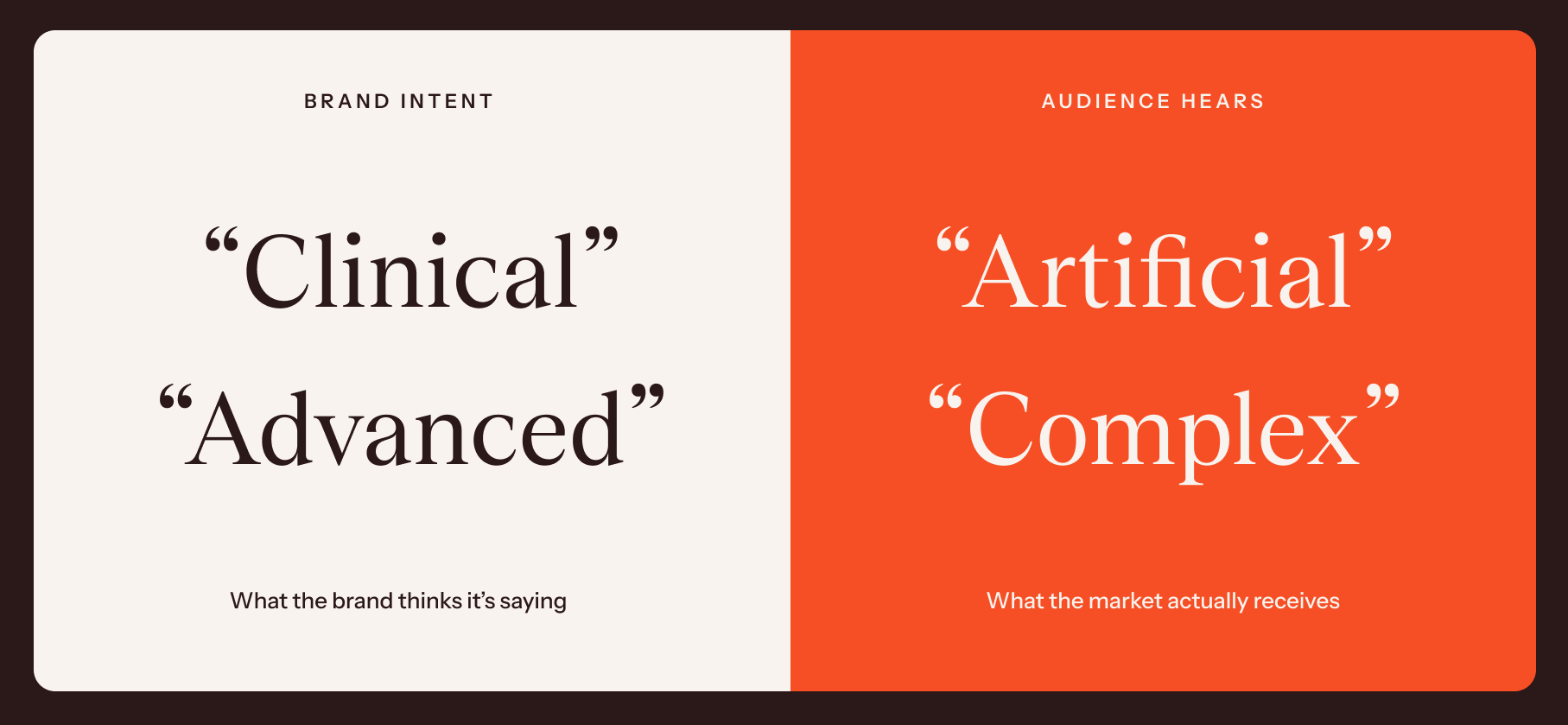
The messaging didn't fail because the team was careless. It failed because customers heard something different than what the brand believed it was saying. What sounded like a strategic decision within the business became a campaign killer in the market.
There’s a better way to approach this longtime challenge, and it’s not to replace creative instinct. It is, however, to pressure-test creative instinct against real audience interpretation before the campaign generates spend, creative production, partner expectations, and executive scrutiny.
Audiense Action makes this a practice, not a project
Our new product Audiense Action is built for the crucial gap between "I don't have time for a research program" and "I'm walking into this room on instinct alone."
It’s a conversational AI platform that empowers marketers to, using plain language and zero code, identify any audience segment they wish to reach. Action then uses billions of signals from our business’ large-scale observed behavioral and cultural data to generate an interactive, intelligent model of that segment.
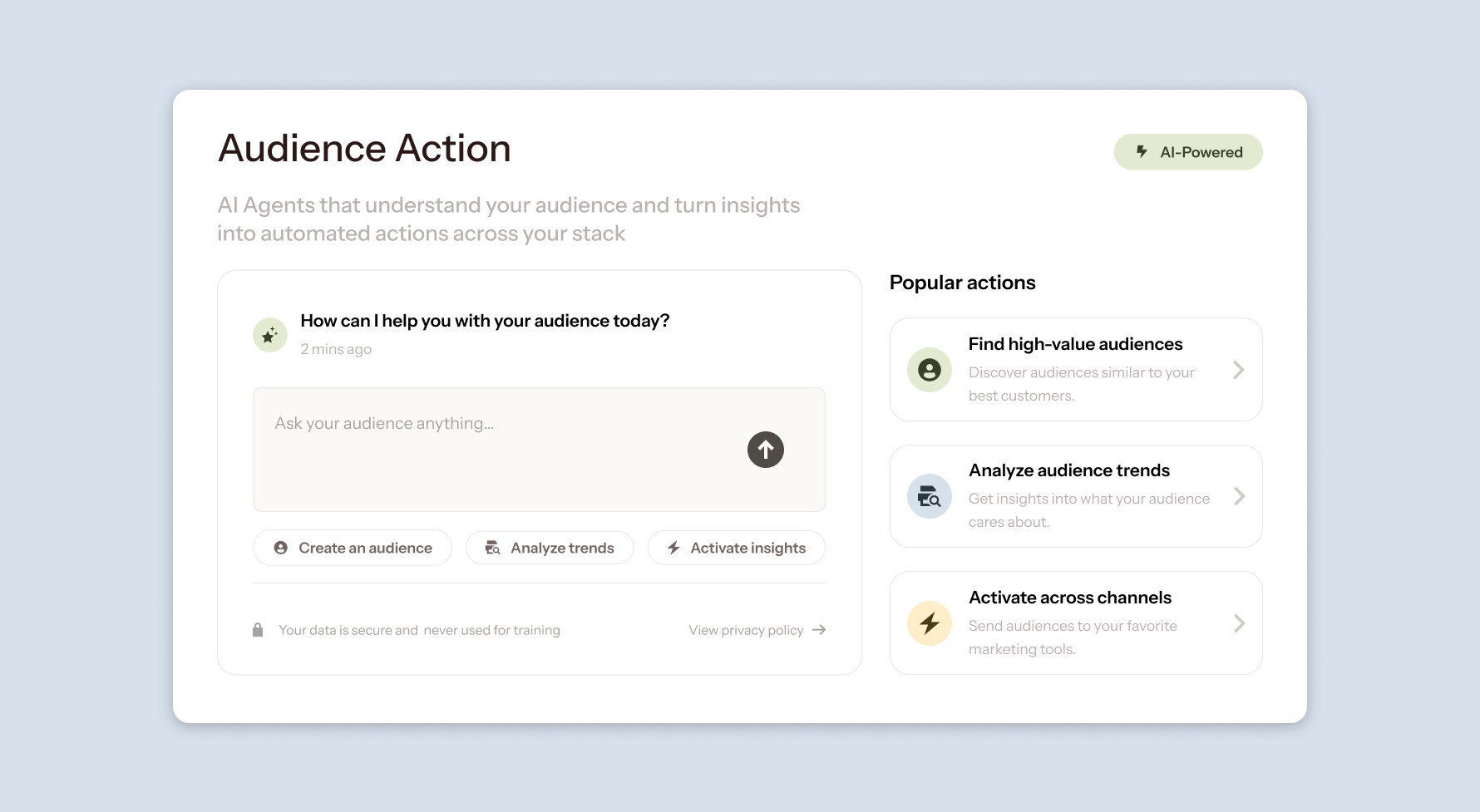
Moments later, you can have a direct conversation, via an intuitive chat interface, with that segment. Ask the segment anything, like:
- How does this message land?
- What does this claim signal?
- Where does this positioning lose you?
- Even... Which version of this value proposition feels more trustworthy?
- Or... What unintended assumptions might this messaging trigger for skeptical buyers?
The model delivers data-backed insights, in the “voice” of the segments, based on how people engage with brands, spend their time, consume media, participate in communities, and make purchase decisions.
To be clear, Action's output isn't a research report that took hundreds of thousands of dollars to create and months to compile, synthesize and translate. Action produces specific, usable findings in real-time, at the scale and pace that working marketers need them. This is the kind of reliable intelligence you can bring into a briefing as "here's what the audience told us" rather than "here's what we think."
A key part the value Action provides is that it makes audience interpretation available while decisions are still being shaped — well before the organization aligns around a premise that might later bomb in the market.
Action’s organizational impact compounds when audience interpretation becomes part of the workflow. The operational impact shows up, fast:
- How much time is spent debating direction versus refining execution
- How quickly cross-functional alignment happens
- How post-campaign reviews get conducted when something goes sideways
The compounding effect
We’ve found that marketers who use this approach also accrue something beyond better campaign decisions: organizational trust. This trust isn’t built on charisma or institutional authority; it’s a consistent ability to explain why a message is likely to work before the campaign launches.
This credibility compounds. Each audience-backed decision makes the next strategic recommendation easier to rally around, because the organization trusts that the instinct is grounded in observable audience response rather than personal preference.
And over time, this habit changes the way decisions get made. Teams spend less time debating direction and more time refining execution. Cross-functional alignment happens faster. And when campaigns miss, the conversation becomes diagnostic instead of political.
That's what audience intelligence does for a senior marketer's position beyond what it does for any individual brief. Instinct doesn't disappear. It becomes sharper, more defensible, and easier for the organization to align around. And over time, the habit of checking changes what marketers notice, question, and bring into the room prepared to defend.
Conclusion
Most marketing disagreements aren't really about creative taste. They're disagreements about what the audience is likely to respond to, filtered through incomplete information, personal experience, and instinct.
The marketing teams most vulnerable to getting this wrong are usually the ones most confident they already understand their customers. Familiarity creates blind spots and echo chambers. Over time, marketers stop hearing their messaging the way the market does.
The teams that navigate those moments best are the ones that treat audience interpretation as something to validate continuously rather than assume implicitly. They understand that alignment within the organization doesn’t guarantee resonance beyond it.
That's the value of using Audiense Action before a campaign launch: it turns strategic instinct into something other teams can align with, defend, and confidently execute.
Because the real risk isn’t simply making the wrong call. It’s making a call the whole organization agrees with, funding it, building around it, and only learning later that the audience heard something else entirely.
Campaign data is downstream evidence, not upstream understanding. It doesn't tell you which assumption, message, or word was doing the wrong work. Audiense Action can.