



Every brand team experiences a version of this story...
Once upon a time, perhaps long ago, the campaign strategy looked good. Like, really good. The message made complete sense in the brief. It sounded right in the creative review. It tested well in concept.
And then the campaign bombed. Why?
Upon reflection, it wasn't the technical execution — that part was flawless. Creative stuck the landing too. No, it was something spookier and squishier than what most marketers are used to dealing with. The message meant something different to the audience than it meant to the team... and despite how well the team understood its customers, they didn’t have a clear way to detect the gap in interpretation before launch.
The villain in this story isn't the team's judgment. It's the nuance of language: the specific categories of words that consistently mean something different to an audience than they mean to the brand using them.
This post is about identifying those categories before the campaign launches, and how tools like Audiense Action give brand marketers fast, reliable ways to close that gap before it costs them.
Four categories where brand meaning and audience meaning most often diverge
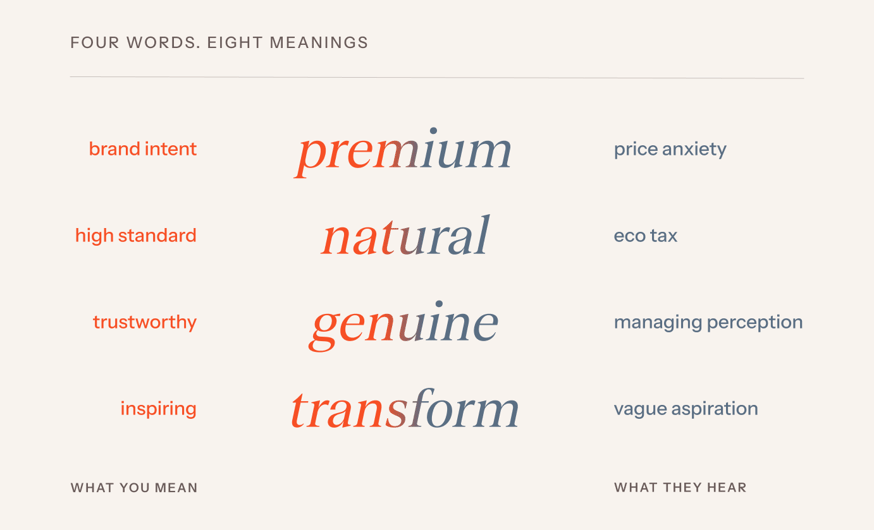
Have you ever noticed that the words most likely to carry unintended meaning are usually the ones your team uses most naturally? These are usually category descriptors, quality signals, and emotional hooks that populate every brief:
- Quality signals: like premium, luxury, elevated
- Sustainability claims: such as responsible, natural, ethical
- Authenticity language: such as genuine, transparent, purpose-driven
- Aspiration hooks: like transform, inspire, journey
These are words your whole category uses, which means they've accumulated associations that aren't yours to control.
These are words your whole category uses, which means they've accumulated associations that aren't yours to control.
For instance: The quality signal verbiage mentioned above — all intended to communicate high standards — can trigger price anxiety instead. Words like premium and elevated send some consumers packing. Here’s why: the quality signal arrives before a case is made for value, which means the first cognitive response is resistance rather than desire.
(Value-leading phrases like built to last, professional-grade, and thoughtfully made often generate better results among those consumers. Specificity is credibility. Tier-claiming is a gamble.)
More for instances: Responsible, natural, and ethical intend to signal values alignment, but often suggest a price-hiking eco tax. And while genuine, transparent, and purpose-driven are supposed to imply trustworthiness, they can also suggest the brand is managing a perception problem.
The question that surfaces this before launch
Knowing that these landmines exist is useful. Knowing whether your current messaging is affected requires a different kind of question than most pre-launch testing asks.
"Which message do you prefer" produces stated preferences — people choose what sounds good rather than what they'd actually respond to. The question that produces useful signal is: "Walk me through what this message means to you. What does it signal about the product? What questions does it raise?"
The second question is a reception question. Where a preference question produces a binary “yea / nay” verdict, a reception question dives under the waterline. It maps the specific cognitive journey a message starts in a consumer's mind and surfaces the why behind the response. That's the useful, strategic information a brief actually needs.
We know that traditional audience research agencies can excavate these insights. But we also know this takes weeks — time that most campaign timelines don't have. So most teams either wait for the research and miss the window or skip it entirely and trust their instincts. Neither is a great option. Audiense Action is built for exactly this... but more on Action in a moment.
Let’s continue with our “yea / nay” vs. “reception question” example. Let’s say a fictional wellness brand tests the phrase "clean and effective" against "works, simply” for an upcoming campaign.
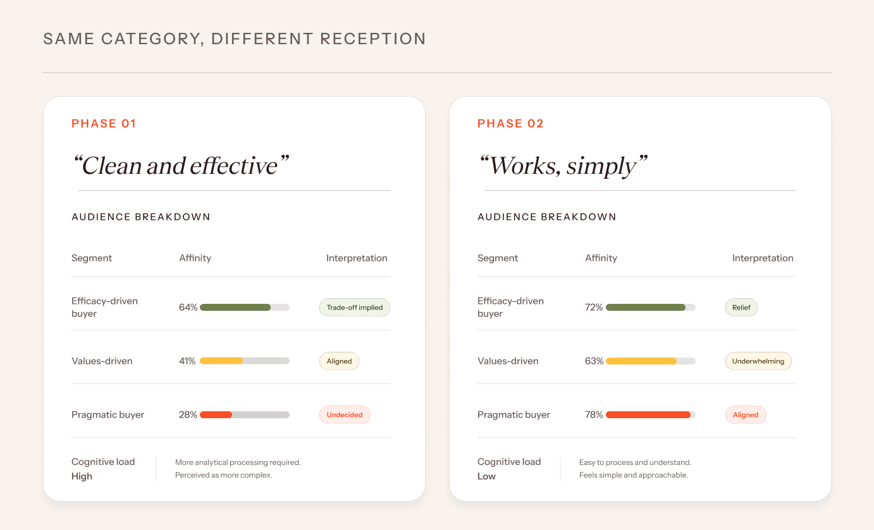
The brand doesn’t know this, but among its customers, "clean and effective" surfaces an assumption of performance trade-off — "clean" reads as a category signal that the product prioritizes purity over potency. However, the phrase "works, simply" doesn't carry that implication. Neither phrase is objectively better. But for a segment whose primary driver is efficacy, the first phrase is doing work the brand didn't intend.
You'd only know that if you asked the right question.
Where Audiense Action comes in
Audiense Action is an AI-powered audience intelligence tool where you build interactive models of real consumer segments and have direct conversations with them via a chat interface.
To be precise, you're not talking to actual people. You're interacting with AI-generated segment models built from billions of behavioral and cultural data points to discover things like:
- How those people in that segment engage with brands
- How they spend their time
- What drives their purchase decisions
The wellness example we mentioned above isn't a thought experiment. It's the kind of conversation that takes minutes in Action... and what comes back isn't just a verdict on which phrase performed better. It's a specific map of what each phrase activates in the consumer's mind, delivered in the segment's own language, before a dollar of media spend has been committed.
Action's value extends well beyond a single messaging decision. It also surfaces up to eight distinct behavioral segments within your overall audience at once and lets you run the same reception question across all of them simultaneously.
Which means you might discover that "works, simply" lands as a relief for a time-pressured, pragmatic buyer — someone who shops the wellness category efficiently and wants a brand that respects that. But it might be a liability for a buyer who uses wellness products as a form of self-expression, for whom "works, simply" signals a brand with nothing interesting to say about itself.
Same phrase. Two segments. Two completely different cognitive journeys.
This is the kind of nuance that changes which phrase leads the campaign — and which segment the campaign leads with. It represents a targeting decision the brief needs to make explicitly before creative starts.
What you do with the finding
Most campaigns don't fail because the creative was weak or the media plan underperformed. They fail because the audience interpreted the message differently than the team intended.
And by the time campaign data exposes that disconnect, the spend is already committed.
That's the real value of Audiense Action. It surfaces the hidden assumptions inside the language before those assumptions become media strategy, creative direction, and budget allocation.
Sometimes the adjustment is small: a descriptor becomes more specific, a claim gets reframed, a phrase disappears before it creates unintended resistance. But those small changes can completely alter the cognitive path a customer takes through the campaign.
The data from a campaign tells you what happened. It doesn't tell you which word was doing the wrong work.