



If you're a brand marketer responsible for growing market share, conquest campaigns often look incredibly promising. It makes so much sense: your competitor already did the hard work of acquiring the customer; all you need to do is convince them to switch.
The problem is that many conquest campaigns begin with an assumption that rarely gets challenged: Were the customers you're targeting ever realistically going to switch in the first place?
The question matters more than most marketers realize because competitor audiences are rarely a single, unified pool of available demand. More often, they're a mixture of very different customer mindsets:
- Some customers are deeply attached to the brands they buy from
- Others are there out of convenience, inertia, or habit
- Still others are experiencing low-grade dissatisfaction but haven't yet acted on it
From a dashboard perspective, those audiences often look identical; they're all customers of the same brand, buying the same products, generating the same revenue. But when it comes to persuading those audiences, they're worlds apart.
Here's where things often go wrong: Most conquest strategies begin with an audience definition that sounds useful but conceals enormous variation within it. By the time the campaign reaches a brief, marketers are often talking about "Nike customers," "Sephora customers," or "Starbucks customers" as though those labels describe a single audience with a shared set of motivations.
But they don’t.
The loyal Nike customer who buys every new release is not the same person as the customer who bought Nike because it happened to be on sale. They may belong to the same brand audience, but they're participating in that relationship for very different reasons.
Segments like “Nike customers” are too broad to be strategically useful. They describe category participation, not emotional posture. And conquest campaigns live or die on emotional posture. Contrary to every marketer's hopes and daydreams, most competitor customers aren't pining for a better ad campaign to change their minds. They already believe, consciously or not, that they found the right option for someone like them.
So, for whatever reason, their relationship with the competition has moved from simple utility into something more habitual and psychologically reinforced. It could be convenience or years-long familiarity. Whatever the reason, they're no longer actively evaluating the category the way marketers assume they are.
People build routines around products. They build identity and trust around them, too. The product becomes "their" airline, "their" retailer, "their" operating system, "their" car company.
This is good news when the customers are yours... and not-so-good news when they're buying from the bad guys.
When marketers ignore this dynamic, conquest campaigns produce weird and unintended outcomes:
- Sometimes the intended audience ignores the campaign completely
- Sometimes it reminds customers why they liked the competitor in the first place
But another portion of this audience exists in a very different state. These consumers feel a growing disconnect — or even a growing discontent — between what they need and what the brand currently represents. They just haven't been given a compelling enough reason to jump ship... yet.
These customers are way more persuadable. But here's the catch: segments within this audience have different motivations for their dissatisfaction. A single message won’t persuade them all.
The hidden problem inside most conquest strategies
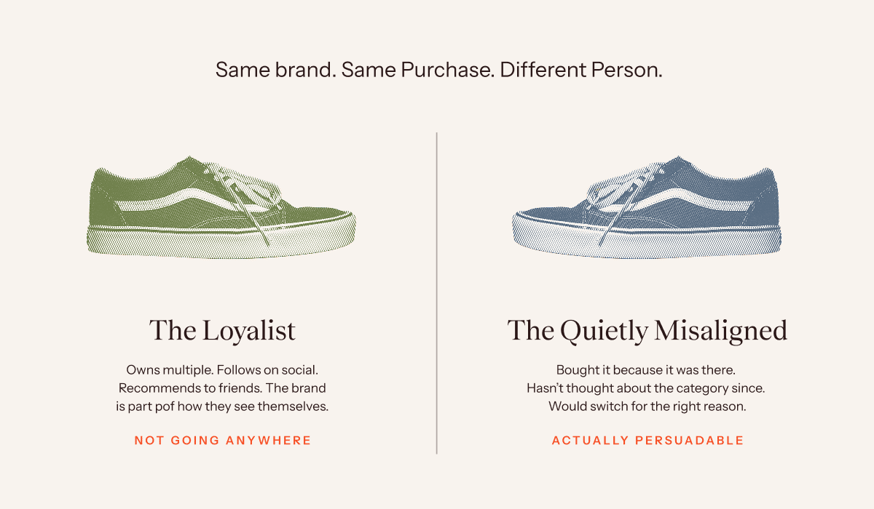
Consider two customers who both buy premium athletic footwear. One has been buying the same brand for a decade, follows the company on social media, owns multiple pairs, and enthusiastically recommends them to friends. The other bought the same brand because it happened to be in stock, hasn't thought much about the category since, and would happily switch if another option felt more compelling.
From a reporting perspective, these customers often look identical — they’re both customers of the same brand, after all. But persuasion-wise, it's Opposite Day. And once a marketing team integrates this misaligned audience definition into a campaign brief...
- The positioning
- The offer strategy
- The media plan
- The creative direction
...suffers an interpretation problem that was never properly challenged in the first place. This becomes an expensive — and to the team, often mysterious — misstep if the campaign bombs.
Marketers often spend enormous amounts of time, money, and creative energy trying to persuade customers who were never genuinely open to persuasion in the first place. Using one-size-fits-all messaging to disrupt even tenuously loyal customers is usually wasted money.
Where switching behavior usually begins
The most persuadable customers are rarely the loudest complainers. In many categories, public dissatisfaction is a poor proxy for switching behavior. Think about the consumer rage on social media... and then consider the reality. People complain about:
- Airlines they continue flying
- Streaming services they continue subscribing to
- Retailers they continue shopping at
Outrage is easy. Changing behavior is harder.
More often, the meaningful opportunity exists inside quieter forms of misalignment. These are issues the incumbent brand either can't see clearly or doesn’t know how to resolve:
- The customer keeps paying but wonders what they're getting in return
- Sometimes the category evolves faster than the incumbent brand
- Customers might want more convenience, flexibility, transparency, or simplicity than the market leader currently provides
- Life gets in the way: customers have kids, move houses, have tighter budgets, have less free time
Put another way, the product hasn't changed but the context surrounding the purchase has. The common thread isn't dissatisfaction; it’s misalignment. The customer isn't necessarily looking to leave. The brand simply fits their current reality “less well” than it used to.
The challenge isn't finding competitor customers. It's understanding them.
Here’s where most marketing teams run into a practical problem: the signals suggesting customer vulnerability are often real enough, but validating them is another matter. Traditional customer research can absolutely answer questions like:
- Why are customers loyal?
- What frustrates them?
- What motivates them to switch brands?
But by the time you've designed the study, recruited participants, fielded the research, analyzed the results, and socialized the findings internally, the opportunity you're investigating may have already changed.
Meanwhile, the brief still needs to ship.
So marketers do what they’ve always done when the decision is important but the evidence is incomplete: they fill the gaps with experience, instinct, internal consensus, and whatever signals happen to be readily available.
Sometimes those assumptions turn out to be correct, and sometimes they don't. The trouble is that most teams don't discover which is which until after the creative is built, the media budget is committed, and the campaign is in the wild.
That's what makes this particular problem so frustrating. Most teams already know that not all competitor customers are equally persuadable. What they lack is a practical way to determine which customers are actually movable before they commit resources to pursuing them.
This is where Audiense Action comes in.
Pressure-testing assumptions before the brief locks
Action is a conversational AI audience intelligence platform that helps marketers build models of consumer segments (with no coding or IT involvement required) and then interact with them to glean valuable intelligence that can inform just about any element of a campaign. These aren’t real consumers, but authoritative, sharply defined proxies informed by billions of datapoints that cross in-person, online, social media activities.
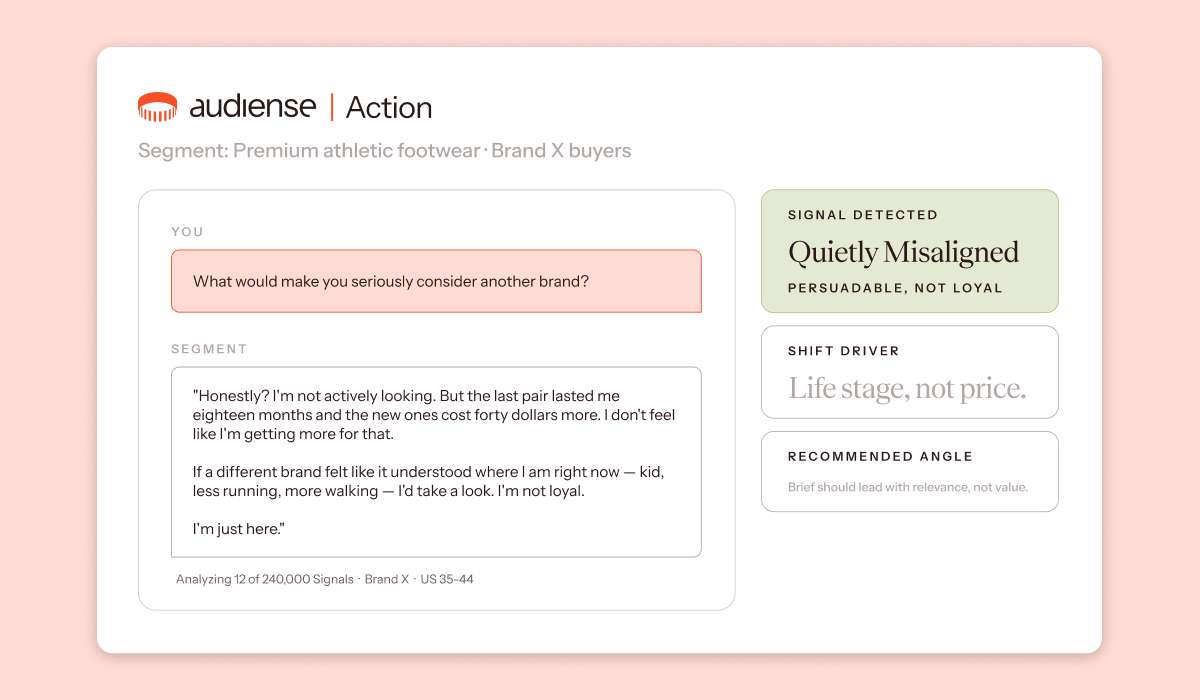
Using a flexible, plain-language “ask me anything” chat interface, marketers can:
- Define audience segments they want to learn about, to a granular level
- Engage the segment as if were a real person (and see the segment’s replies, which are written in first-person, often in the voice that person)
- Ask questions, test assumptions, and explore how the segment engages with brands, consumes media, and makes purchase decisions
The result isn't a static report. It's an illuminating conversation that can explore assumptions, compare audience segments, test messaging, and pressure-test campaign ideas... all before the brief goes out the door.
That's what makes Action particularly useful in conquest marketing. The challenge usually isn't finding competitor customers. It's understanding which of those customers are actually open to persuasion and why.
Imagine you're prepping a conquest campaign aimed at a competitor's dissatisfied customers. Maybe your team believes they're frustrated by rising prices. Maybe you think the brand has lost relevance with younger consumers. Maybe the market has shifted, but the bad guys are still using an outdated playbook.
Those are reasonable hypotheses. They're also still hypotheses. Historically, you'd build the strategy around your best interpretation of what's happening. You'd look at available data, draw reasonable conclusions, and move forward.
Using Action takes you a step further. Now, you can explore questions that typically go unanswered due to time and budget constraints:
- What keeps you buying from this brand?
- What frustrates you about the experience?
- What no longer feels worth the premium?
- What would make you seriously consider another option?
- Which messages feel relevant and which immediately feel dismissible?
Action is purpose-built for demystification. It provides customer clarity backed by billions of Audiense customer signals (and breakthrough AI analysis).
The strongest campaigns are built on validated understanding, not educated guesswork. Otherwise, you're essentially wrapping wishful thinking in a convincing strategy deck and hoping reality cooperates.
And conquest planning is only one use case. Marketing teams also use Action to:
- Identify new audience segments for product launches
- Evaluate messaging before it reaches the market
- Compare consumer perceptions across competing brands
- Generate audience-informed creative briefs
- Explore channel strategies tailored to specific customer segments
In each case, the underlying value proposition is the same: helping marketers make better decisions faster by reducing the number of assumptions they have to make along the way.
Winning before the campaign launches
Conquest campaigns fail because the team misunderstood the audience before the creative process even began.
The strongest conquest strategies start by recognizing that competitor customers are not a single audience. They're a collection of different motivations, loyalties, frustrations, and different levels of openness to change. The challenge is knowing the difference.
That's where Audiense Action creates value. The solution doesn’t replace formal research or predict future performance, but it does help marketers pressure-test audience assumptions before messaging, creative direction, and media spend become commitments rather than ideas.
Because the goal was never to take loyal customers away from your competitors. The goal is to find the customers your competitors are already in the process of losing — and understand them well enough to give them a reason to choose something better.